ONOZU — UNITED KINGDOM
Cloud Shadows on the South Downs
Across the South Downs, passing cloud divides the slopes into bands of light, making familiar contours appear and disappear.
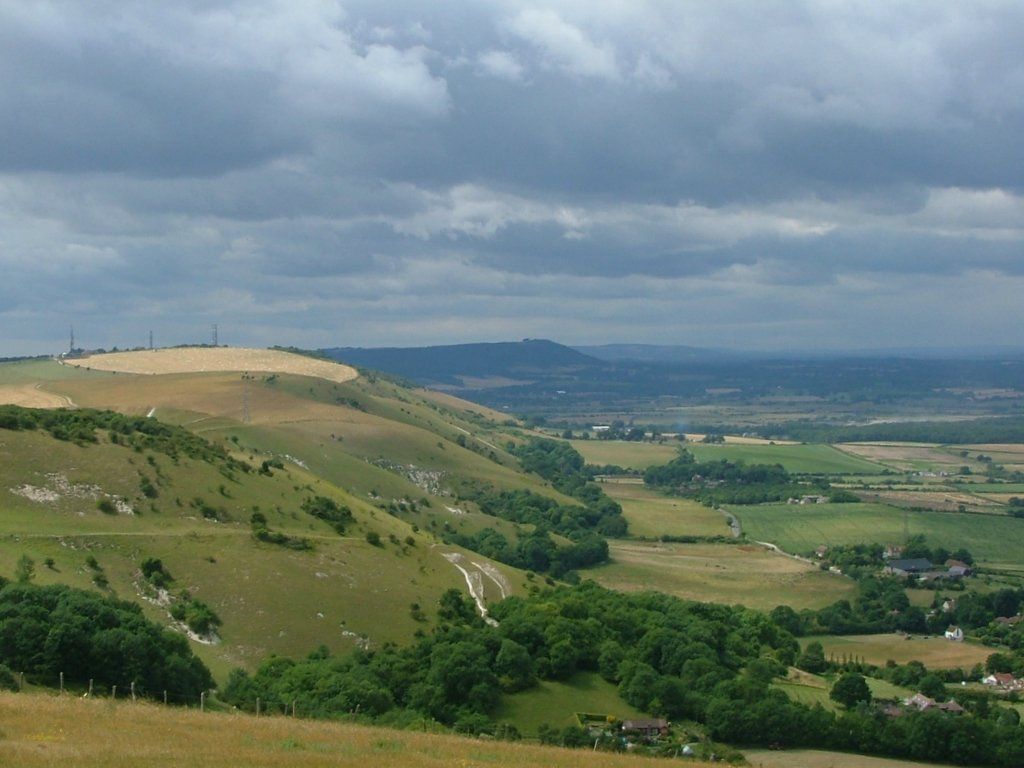
South Downs View by Les Chatfield. Source, licensed under CC BY 2.0. Auto-oriented, resized without enlargement, metadata stripped, and recompressed; responsive AVIF/WebP derivatives are generated at build time.

On an open slope in the South Downs, a passing cloud can change the view before there is time to name what has changed. A green shoulder loses its brightness. The field beyond it becomes clearer, and a distant line of trees separates from the darker ground. The hills keep their shape, but the order in which the eye meets them shifts.
These changes are easier to notice when the sky has both cloud and clear intervals. Under steady sunshine, the nearest grass and the farthest fields can compete for attention. With cloud moving overhead, the landscape arrives in portions. A lit ridge seems close for a moment, then recedes as another patch of ground brightens.
The shape beneath the light
The rounded slopes do not need a dramatic sunset to become legible. Ordinary afternoon light is enough. Where a slope turns away from the sun, the green deepens gradually rather than stopping at a sharp edge. A shallow fold can remain almost invisible until its neighbour catches a brighter interval.
Field boundaries provide a different measure of distance. A hedge is first a dark stroke, then a row with gaps and individual crowns. Farther away, those details merge again. Looking across the fields is a repeated adjustment between surface and pattern: grass near the path, a fence lower down, small enclosed shapes towards the horizon.
Wind adds movement at a smaller scale. Along the crest, grass tips bend together and return in uneven groups. A sheltered hollow may look still at the same moment. The movement makes the exposure of each part of the hill visible without any need to measure it.
Waiting through an interval
There is a temptation to treat a bright opening as the correct version of the view. Yet the darker intervals explain just as much. They soften distant detail, bring the nearest stems forward and make a pale path stand out against the turf. Staying for a few minutes gives the same place several different arrangements.
This note is about that ordinary succession, rather than the weather of one recorded walk. The accompanying photograph shows the South Downs in Sussex; it is an illustration of the terrain, not evidence of today’s conditions. The useful habit is simply to pause long enough for a shadow to pass and watch which parts of the landscape return first.